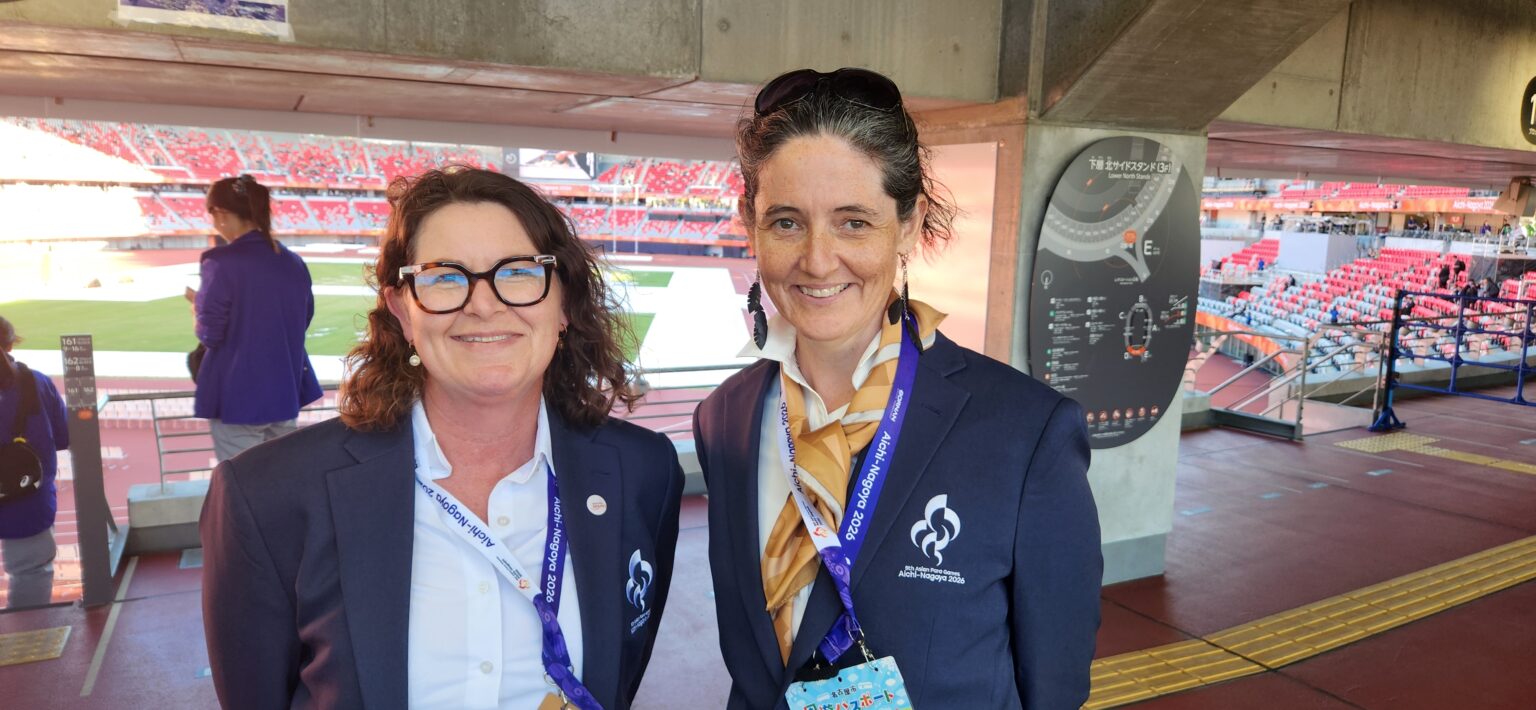
A pair of Aotearoa New Zealand-based classifiers attended the Asian Para Games in Aichi-Nagoya (18-24 October). We chat to Renee Edgar and Kerry Jenkinson about their respective classification journeys.
Renee Edgar
As an optometrist with an extensive background in sports vision, Renee Edgar has spent some of her professional life focused on helping athletes maximise their visual performance.
So, when Paralympics New Zealand (PNZ) encouraged her to submit an expression of interest for a Vision Impairment (VI) Classification course 12 years ago, it was an opportunity she readily embraced.
“It felt like a natural fit for me because I have that interest in sports vision,” explains Renee, who works with several sporting teams to enhance their visual performance, including the Wellington Firebirds cricket team.
“I completed the course in Wellington, and it felt great to know I could give something back to the vision-impaired community – a section of the community that, as optometrists, we don’t often get the opportunity to help.”
In 2022, Renee became Aotearoa New Zealand’s first internationally certified VI Classifier, completing her international certification in Malawi. Since then, she has been called upon to officiate at several major international events, including the 2023 Parapan American Games in Santiago and the 2026 Asian Para Games in Aichi-Nagoya, Japan.
The role has opened the door to some exciting opportunities, but what exactly does VI classification involve?
“Our role as international VI classifiers is different from that of physical impairment classifiers, in that we only undertake medical classification. We don’t need to observe Para athletes in competition.
“Our role is to measure vision in a consistent way so that competition is fair for everyone. Generally, there are three vision impairment classifications, ranging from B1 (the most significant vision impairment) through to B2 and B3, representing progressively lesser levels of impairment.
Vision is assessed using a LogMAR chart, with Para athletes asked to identify the direction in which the arms of a letter ‘E’ are pointing. Their vision is tested across a range of distances and viewing conditions to establish an accurate and consistent assessment.
For Wellington-based Renee, however, the classification process is not without its challenges. As with other areas of Para sport, deliberate misrepresentation of impairment can occur.
“If a Para athlete is placed in a lower classification but has greater visual function than the other Para athletes, they are competing against, it gives them a significant advantage”, explains Renee. “Identifying those who might be deliberately misrepresenting their vision and ensuring everyone competes in the fairest possible class is our biggest challenge.”
Renee and her fellow classifiers use a range of techniques during the assessment process to identify inconsistencies. But there is another, equally difficult aspect of the role: having to tell a Para athlete they do not meet the minimum impairment criteria to be eligible for classification.
“They often have an impairment but don’t meet the minimum impairment criteria,” she says. “To tell them they are ineligible breaks my heart.”
Despite these challenges, Renee says the rewards of classification far outweigh the difficult moments.
“From a national perspective, making connections with the likes of Paralympian #194 Emma Foy and Para sprinter Amy Ellis, and then seeing them go on to excel has been incredibly rewarding.
“Internationally, I’ve also had the opportunity to experience things we don’t necessarily get exposure to in New Zealand, including different eye conditions. From an optometrist’s perspective, that’s been professionally very interesting.”
Becoming a classifier has enriched Renee’s life in numerous ways, and she would readily encourage others to consider following a similar path.
“Classification is the cornerstone of Para sport, and to play a part in ensuring Para athletes are competing in the appropriate Para sport class has been really rewarding,” she explains. “It’s been incredibly satisfying to help vision-impaired people who want to pursue Para sport, and humbling to connect with these amazing people.”
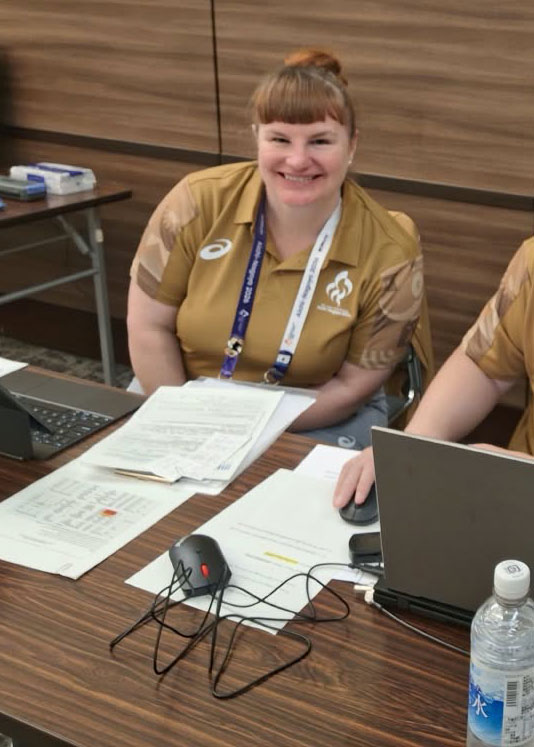
Kerry Jenkinson
Having been involved in Boccia for more than a quarter of a century, Kerry Jenkinson has developed a deep and enduring connection with the Para sport. As Aotearoa New Zealand’s only Technical Classifier for Boccia, she has played a vital role in supporting Para athletes, while the Para sport itself has enriched her life in countless ways.
Kerry’s journey with Boccia began in the late 1990s while she was studying for a degree in Sport and Recreation. During this time, she became involved with CCS Disability Action, which introduced her to Boccia – a precision ball sport designed for people with physical impairments that affect their movement patterns.
After connecting with Paralympics New Zealand (PNZ), Kerry met Rebecca Foulsham, now PNZ’s Classification Project Lead, in 2001. Inspired to become more involved, she decided to pursue a qualification as a Boccia Technical Classifier. Five years later, she completed her international classification certification.
“For me, the attraction to becoming involved was the opportunity to support Para athletes with high support needs who perhaps don’t have any other Para sporting options available to them. Boccia is probably the only Para sport where they can compete on a level playing field.”
For a prospective Boccia player to be classified, they must have an underlying health condition. It is the Medical Classifier’s role to determine whether that condition meets Boccia’s minimum impairment criteria. The Technical Classifier then determines the specific Para sport class in which the player will compete.
“Our role is really to confirm on the court what we see in the medical classification room,” explains Kerry. “We are assessing not just isolated muscle movement, but also how the muscles work together and how that can impact movement patterns.”
One of the challenges of classification is the potential for Para athletes to misrepresent their abilities. However, Kerry says careful observation, both during and outside formal assessments, can help identify inconsistencies.
Having said that, Kerry is quick to stress that the vast majority of Para athletes going through classification are not deliberately trying to misrepresent their abilities.
Her involvement in Boccia has also taken her around the world. She served as Team Manager for the NZ Paralympic Team’s Boccia squad at the Athens 2004 and Beijing 2008 Paralympic Games and has forged countless friendships through the Para sport. It was also through Boccia that she met her now husband, Trevor, a coach with Boccia NZ. Their children have since become involved in Boccia, too.
While the opportunities to travel, the friendships, and the personal connections have all been hugely rewarding, Kerry says the greatest satisfaction comes from seeing the difference Boccia makes to the lives of its players.
“Many Boccia players don’t work or have minimal involvement in their communities because of their high levels of impairment,” she says. “Yet Boccia gives them direction and meaning. It has been completely life-changing for them.”