Nobody has made a more significant contribution to the sport of Para alpine skiing in Aotearoa New Zealand than the late Gillian Hall QSM. Through the voice of her husband, Tony, her daughter, Anna, and others in the snow sports community, we reflect on her extraordinary influence.
Quite simply Gillian “Gilly” Hall was the Godmother of Para alpine skiing in Aotearoa New Zealand. Thanks to her passion, drive and tenaciousness, the South Islander forged a pathway for disabled people to discover the freedom and joy of skiing.
Her pioneering actions enabling the Para sport to thrive in the disabled community in this country and opened the gateway to the NZ Paralympic Team winning a total of 35 Paralympic Winter Games medals over the past 42 years.
Travelling to the USA to find out more about disabled skiing, aged just 23, revealed her drive and fortitude. But it also triggered a lifelong advocacy in the rehabilitative and health benefits of Para alpine skiing until her tragic passing in 2009 at the age of 58 following a short battle with cancer.
Her husband Tony reflects on his late wife’s remarkable legacy.
“Looking back, to pack herself off to Colorado and learn about disabled skiing with no support was very courageous,” says Tony, who married Gilly in 1977, just six months after first meeting ‘the love of his life’. “There is no way at the same age I would have tackled something so ambitious.”
Yet that was Gilly, who would never take no for an answer and who made an unparalleled contribution to Para alpine skiing.
Born and raised in Dunedin, Gilly and her family embraced the outdoors, and she quickly learned to love skiing and the mountains. After leaving school she became a qualified physiotherapist in 1971, before relocating to Queenstown the following year to work as a ski instructor and part-time physiotherapist. Keen to share her love of skiing with others, she completed stage one and two of the NZ Instructors Certificate.
Her road into adaptive skiing began by chance. In 1975 a group of American ski instructors visiting Aotearoa New Zealand asked her why there was no disabled ski programme in the country. Curious, Gilly investigated and discovered no such programme existed in Aotearoa New Zealand.
She flew to Winter Park in Colorado and met Larry Lash, who used adaptive skiing to aid the rehabilitation of US Vietnam War veterans, to gain a greater understanding of what was required to build a similar programme.
Yet it was not a straightforward process for a young Kiwi woman to step into a largely male-dominated world.
“Back then it was a battle,” admits Tony. “On her arrival at Winter Park, she hoped to be welcomed but the first question she was asked was ‘what are you doing here, you are just a girl?’ She then had to go up the mountain with a shovel on her back and do some work on the trails.
“It took a while to win their trust, so she could become a part of the team.”
Undeterred, she learned a lot from the programme, and transferred that knowledge back to her country. Instrumental in setting up the Association of Disabled Skiers in 1976, the organisation developed into a registered charity with a network of branches and programmes set up around the country.
As the organisation grew, Gilly looked to bring in good people to further enhance her vision. Ros Service played a critical role in the Canterbury branch of the Association of Disabled Skiers. US-based Kiwi ski instructor David Boyd recalls Gilly had called and set up an interview from the maternity hospital in Christchurch the day after her son, David, was born.
“I had no experience teaching disabled skiing, but Gilly realised from the beginning the key was to teach the teachers, that was to be my job,” he explains. “That very early part of the programme was very well thought out. We already had various branches across New Zealand and then in association with that you would have a ski area affiliated with that branch. There was a lot of work coordinating with the ski schools to understand what we were trying to do. Besides her vision and ability to delegate, Gilly never had any excuses. Once she set her mind on achieving a goal, there was no stopping her.”
The snow sports industry backed her vision and prominent businessmen including Maurice Paykel (the co-founder of Fisher and Paykel) and Sir Roy McKenzie (philanthropist) were particularly generous.
However, as Tony admits, financially it was not always easy.
“Gilly and I would organise raffles, and I once remember underwriting the cost of a car for one raffle,” he explains. “We were lucky in that was raised $30,000, but it came with big risks.”
By the early 1980s, Gilly and Tony had three young kids; David, Anna and Nicky – and Anna recalls the impact her mother’s passion for disabled skiing had around their home in Waikuku, northth of Christchurch.
“I remember many meetings with lots of wheelchairs around, which as kids we used to race around the family home,” recalls Anna. “It was a cool environment to be part of. I remember the fun and energy.”
Gilly also acknowledged a need for disabled skiers to be given the chance to compete in Para alpine ski racing and she was instrumental in the attendance of the first NZ Paralympic Team to compete at a Paralympic Winter Games, in Geilo 1980.
One such person Gilly helped attract to the Para sport was Paralympian #44 Mark Edwards. Born with spina bifida, a call to his parents from CCS Disability Action (what was then known as the New Zealand Crippled Children Society) that Mark should try Para alpine skiing instantly appealed. Keen on trying outdoor pursuits, it was Gilly who was present at his first ‘have a go’ experience at Mt Hutt and it is obvious the seismic impact she made on his life.
“Gillian was an amazing people person, who always took a huge interest in you and what you were doing in your life,” he explains. “It did not take long for me to love skiing. Gilly left a huge impression on me.”
Mark went on to compete for the NZ Paralympic Team at the Innsbruck 1984 Paralympic Winter Games, where New Zealand claimed an impressive haul of five medals.
Paralympian #45 Viv Gapes excelled claiming one gold and two silver medals with Paralympian #46 Christopher Orr taking a silver medal. Mark himself banked bronze in the Men’s Downhill LW3, as this unlikely band of Para athletes – many of whom were competing on the international stage for the first time – made a real statement.
“I was immensely proud of how that whole Team come together and behind that engine, Gilly enabled this to happen,” explains Mark. “She was not doing it all herself but by having great people around her we had come on so much further as a Team. All eight Para athletes who competed at Innsbruck 1984 have succeeded in their various fields since retiring from competitive skiing and I think that was from the confidence gained of skiing at the highest level.”
A Team physiotherapist for the NZ Paralympic Team at the Nagano 1998 Paralympic Winter Games, Gilly later became an international classifier working in the role at the Salt Lake City 2002 and Torino 2006 Paralympic Winter Games. Until her retirement because of illness, she worked as Head of Classification for the International Paralympic Committee (IPC) Para alpine skiing Sport Technical Committee.
Tony says the early days of Gilly’s involvement in classification required an innovative approach.
“They worked without a computer and with just paper and a ballpoint pen – neither of which wanted to work in sub-zero temperatures,” he says. “So, they were real pioneers in terms of classification.”
She also led the merger between Disabled Snowsports NZ and SnowSports NZ, which helped ensure the long-term future of disabled Para alpine skiing in Aotearoa New Zealand.
Her legacy is assured in the vibrancy of Para alpine skiing in Aotearoa New Zealand. This will be illustrated at the Milano Cortina 2026 Paralympic Winter Games (6-15 March) when the NZ Paralympic Team will seek to add to their rich history of achievement on the biggest stage, none of which would have been possible without the drive and passion of Gilly.
Reflecting on her legacy, daughter Anna explains: “Mum was dedicated and driven and passionate about the snow – she lived and breathed it, which is probably something I didn’t realise when I was young. To me, she was a great mum who was always around but looking back her commitment to Para alpine skiing was special and unique. She had this amazing drive to support people with a disability and gave them every opportunity to ski, which was pretty neat.”
For David, Gilly was a selfless and modest, but a fierce advocate for disability skiing,
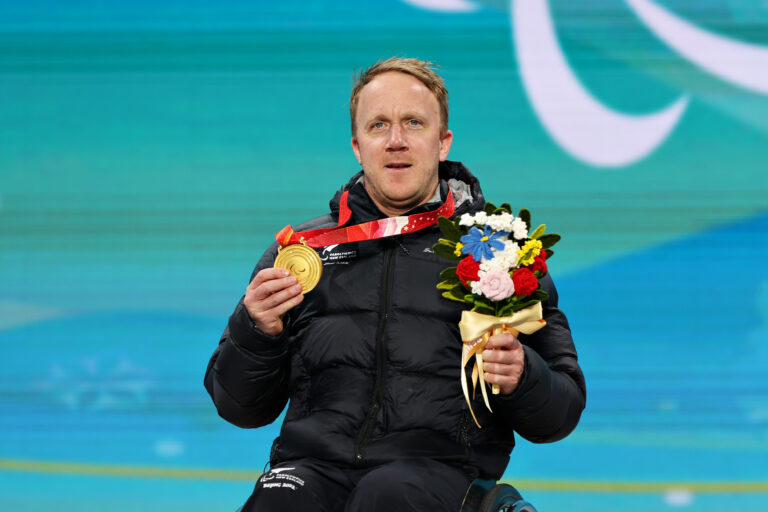
“She was a quietly determined trailblazer,” insists David. “She wasn’t flashy, she wasn’t going to yell and scream, she wasn’t going out to make a big noise unless it helped the profile of the programme. Gilly helped set in motion what we will see at the Milano Cortina 2026 Paralympic Winter Games, New Zealand athletes’ Paralympian #158 Adam Hall MNZM and Paralympian #188 Corey Peters MNZM – led by NZ Paralympic Team Chef de Mission Jane Stevens, who was a good friend of Gilly’s, competing against the best in the world and fighting for medals.”
Mark agrees that Gilly’s legacy is the vibrant Para alpine skiing community we see today in Aotearoa New Zealand. And from a personal perspective he cannot put a price on what Gilly gave Mark personally by introducing him to the Para sport.
“She instilled in me a lifelong love of the mountains and a confidence I’ve taken into the rest of my life because of skiing,” says Mark. “I have seen many Para skiers develop, grow and shine and go on to do amazing things in their life and that’s down to Gilly. I too feel I’ve greatly benefit from that.”
It is now 17 years since Gilly’s premature passing, but her legacy lives on. Husband Tony says Para alpine skiing in Aotearoa New Zealand has become ‘normalised’ thanks to his late wife.
Yet for Tony, who himself has sponsored and supported Adam and Corey among other Paralympic winter athletes, there is no doubting the huge influence Gilly played in his life.
“I’ve been involved in many not-for-profit organisations and Gilly paved the way for that,” he says. “She taught me that the rewards of giving were far greater than taking. That’s how we operated as a family – that was a gift that Gilly gave me.”