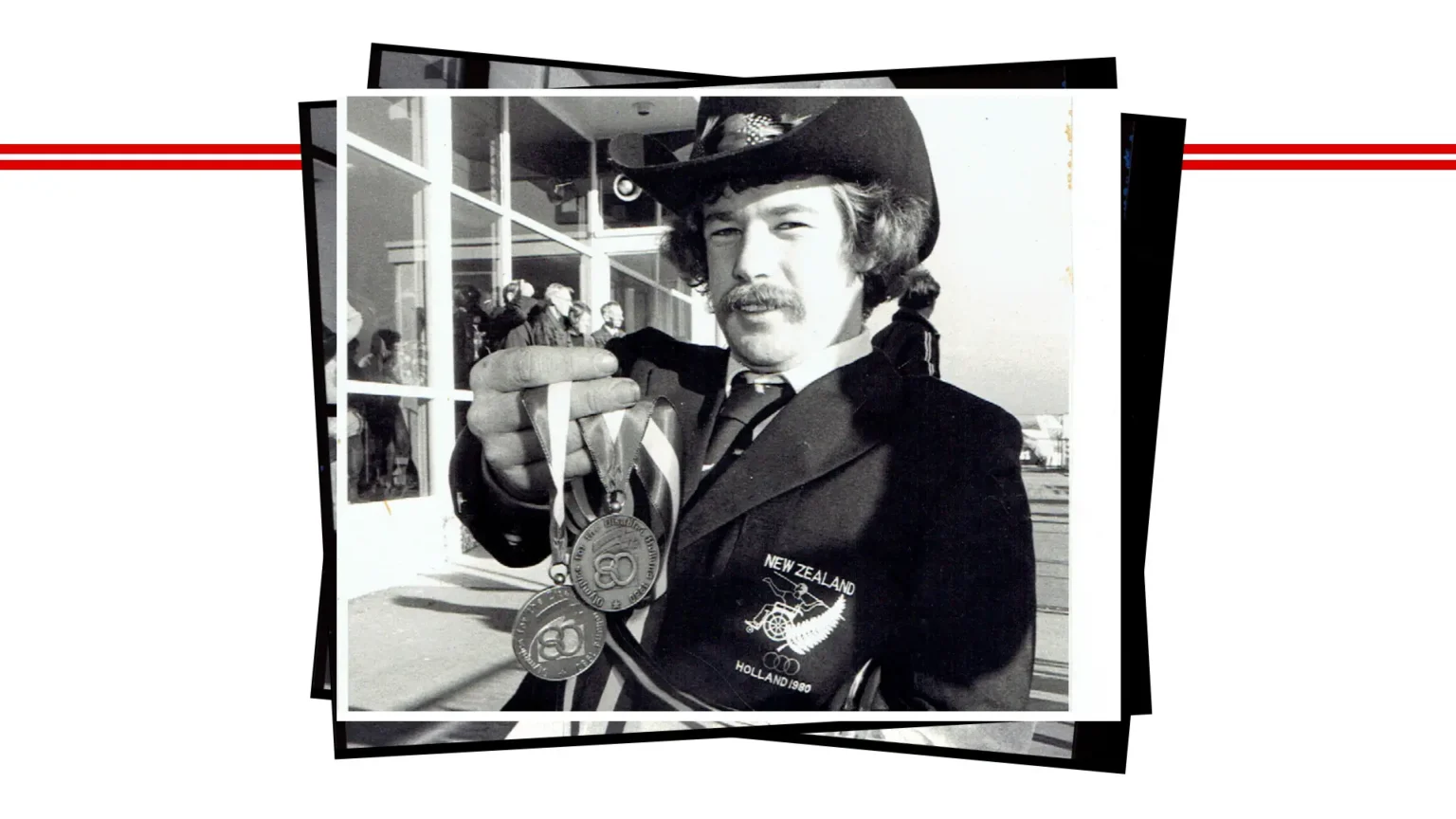
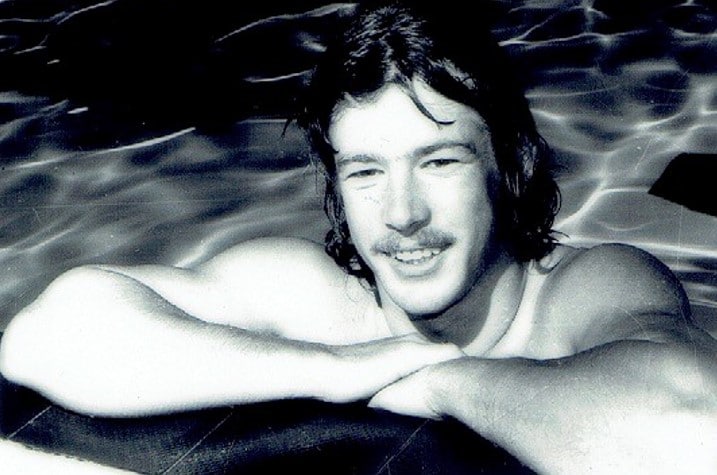
In the first part of our series reflecting on the 50th anniversary of the Toronto 1976 Paralympic Games, we chat to Paralympian #22 Paul Chambers about the important role Toronto 1976 played in his career which was capped with gold at Arnhem 1980.
The transformative power of Para sport can perhaps be best summed by the accomplishments of Paul Chambers who just three years after sustaining a spinal cord injury, was riding high on the medal podium at the Toronto 1976 Paralympic Games.
Stunned and surprised to have claimed an unexpected bronze medal in the Men’s 50m Breaststroke 4, Para swimming had given the Hawke’s Bay local purpose and clear direction.
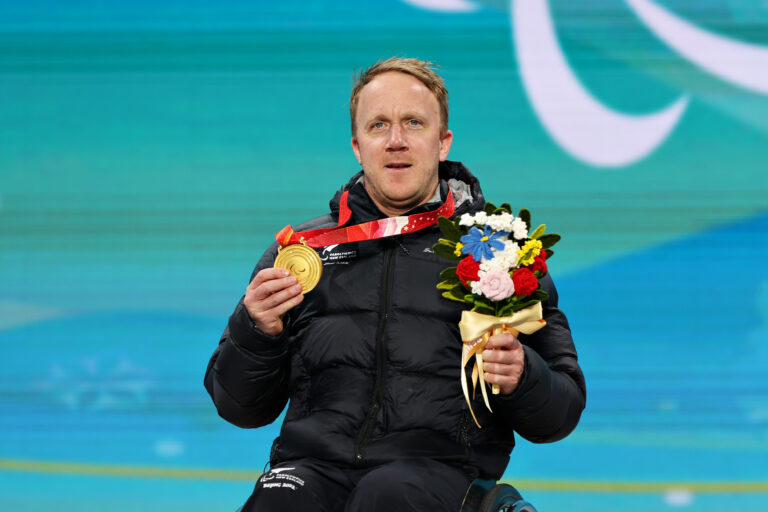
So much so, that four years later at Arnhem 1980, the Kiwi achieved the crowning glory of his career when striking gold with a world record in the Men’s 100m Breaststroke 4.
“Winning Paralympic medals and becoming a Paralympic champion gave me confidence in myself not only to achieve in Para sport, but in all areas of my life,” reasons Paul now aged 72.
Born and raised in Hastings, Paul enjoyed an active upbringing. A club rugby player, he also competed as a motorbike speedway rider and was a keen free diver. However, his life was to change in August 1973 when the apprentice boilermaker had an accident while working on a ship and sustained spinal cord injuries.
A competitive swimmer in his youth, who raced and sometimes beat fellow Hawke’s Bay resident and 1976 Olympian John Coutts, he used swimming to aid his rehabilitation, and it was his good fortune that he connected with Doreen Scullin as his coach.
“I remember first turning up to the pool and I was very self-conscious because I’d had quite a lot of muscle wastage following the accident,” he says. “She told me to either get in the pool or stay out, she was pretty hard nosed about it, but it was what I needed. I couldn’t even swim 25m back then, but I went back every day and just plodded away.”
Making his Para sport debut – competing in a range of Para sports including Para swimming – at the 1974 Kawerau Friendly Games – was a hugely positive experience and such was his ability and progress in 1975, he was selected to compete at the Far East and South Pacific (FESPIC) Games in Beppu, Japan.
Training daily at the 25m pool at the Napier Aquatic Centre provided perfect preparation and although the rules of the FESPIC Games limited each competitor to one event per Para sport, winning gold in the Men’s 50m Freestyle 4 gave him huge encouragement.
Despite his success in Japan, Paul dismissed any possibility of winning selection for Toronto 1976. Yet after setting multiple national records at the 1976 New Zealand Swimming Championships, he was both “excited and overwhelmed” to receive a phone call to say he had secured selection for Toronto 1976.
“I was surprised and, in my mind, I wasn’t ready”, he recalls. “Put it this way, I would not have been disappointed had I not been selected.”
During training he was encouraged to find he was within touching distance of the world record time for the Men’s 50m Breaststroke 4.
“Even though I trained in a 25m pool with three turns as opposed to one turn in a 50m length pool, I knew I was close to the mark to compete with others. Even so, I thought reaching finals in Toronto would be a good result for me.”
His first ever time travelling on a Boeing 747, he says being part of the NZ Paralympic Team environment was a memorable experience. He recalls that the support staff were “fantastic” and the strong bonds he forged with the 12-strong Team.
“We were all good mates,” he says. “I’ve got a lot of time and respect for Jim Savage (Paralympian #14 PLY MBE), Bill Lean (Paralympian #7), Reuben Ngata (Paralympian #10) and Graham Condon (Paralympian #4 QSM). I roomed with Fred Creba (Paralympian #23) in the university campus during Games-time, and the facilities were fantastic. Jim (Savage) was the team captain and even though he has his own events, he would always endeavour to support the newbies. He was a great inspiration.”
Opting not to attend the Opening Ceremony to prepare for his first competition the following day, Paul reached five Para swimming finals across the programme with the highlight a bronze medal in the Men’s 50m Breaststroke. The third quickest of the qualifiers into the final he set himself a clear tactical goal in the final.
“I knew I could get a podium finish, but I had to be wary of going out too hard in the first 25m,” he explains. Maintaining his composure, he swam almost one full second quicker in the final then in the heat, he registered 47.79 for bronze.
“To stand on the podium was great, surreal,” he recalls. “I was proud. To have trained so hard and to see the flag raised was a big moment. I set out to reach finals but to win a medal was the cream on top.”
Married to current wife, Linda, later that year, Toronto 1976 proved the catalyst for his success at Arnhem 1980. Fuelled by a new level of belief and motivation and under the continued guidance of Scullin, he delivered his dreams of gold in the Men’s 100m Breaststroke 4 with a stunning performance.
Setting a world record of 1:45.49 to top the qualifiers heading into the final he delivered in the medal race claiming gold by almost two-and-a-half seconds, clocking a new world record mark of 1:43.06.
“It is a big thing to set yourself such a big goal and to go on and achieve it,” he explains. “I didn’t expect to break the world record in the heat and to do so again in the final was unreal. It was a great feeling.”
Arnhem 1980 was to provide the full stop to his international career as he sought to focus on his work and family life. He later worked as a progress purchasing clerk at an engineering company and later served as a manager. With four children and six grandchildren he is now happily retired and lives in Clive.
Paul is no longer actively involved in Para sport today but keeps a keen eye on the NZ Paralympic Team at the Paralympic Games. Immensely proud of his Para swimming achievements, he says competing in Para sport has given him so much.
“It was everything. If I hadn’t have got out and done Para swimming my life would have been totally different. Being involved in a Para sport gave me so much confidence.”