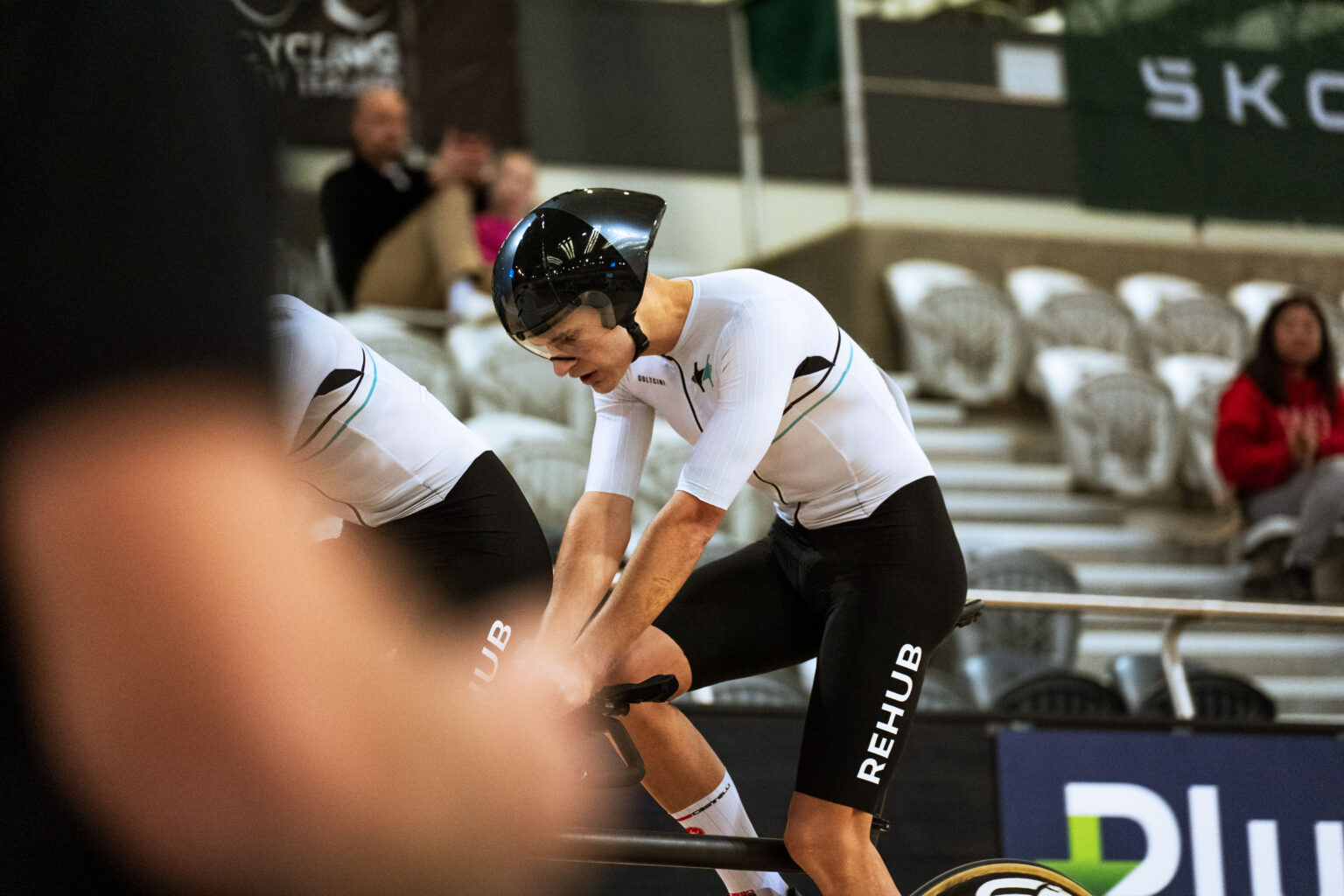
Most elite Para athletes spend years striving to reach the top of a single Para sport. Michael Whittaker is chasing success in three.
Already a Para Athletics World Championships finalist, and a New Zealand record-holder in Para cycling, the Aucklander is now adding Para swimming to his repertoire as he targets his debut at the Oceania Para triathlon Championships in November.
The rise of Whittaker, a vision impaired Para athlete, has been nothing short of extraordinary. The former catwalk model who was diagnosed in his mid-20s with retinitis pigmentosa – a genetic condition that causes progressive vision loss – only first discovered a talent for running during the COVID-19 lockdown. Yet he is more than making up for lost time.
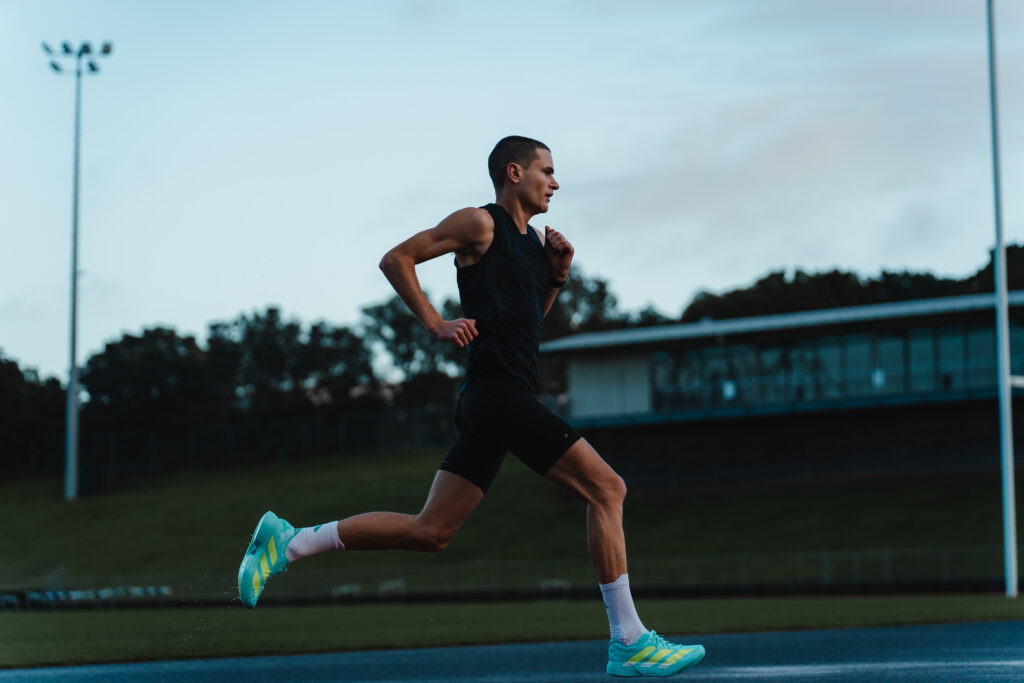
Now aged 36, he only took up serious running in 2023 and two years later finished eighth on his New Zealand debut in the Men’s 5000m T13 at the 2025 World Para Athletics Championships, clocking 15:38.13.
More recently he has excelled on the velodrome, smashing the New Zealand record for the Men’s 4000m Individual Pursuit. Now, combining his background in running and Para cycling, he has decided to add a third discipline to the mix by taking on Para swimming. In November he plans to bring all three together when he contests the Oceania Para triathlon Championships in Auckland.
“Given that Para triathlon is a sprint-distance, I think I am well-suited to both the 5000m run distance and 20km cycle leg. There is, however, the small matter of the 750m swim that it opens with,” laughs Michael. “I’m pretty sure I did a tiny bit of swimming in my early teens, and I’m hoping that somehow helps – because I need all the help I can get. Since targeting the event I have managed to get four swimming lessons under my belt. It is coming along well, to be fair, but I’m certainly aware the improvement curve is steepest at the very start.”
Satisfied with his top-eight finish in New Delhi, Michael believes the experience proved invaluable.
“I had only ever previously run against sighted people. As soon as the gun went off in New Delhi it was like roller derby,” he recalls. “There were elbows everywhere, rogue lane changes, and trips aplenty. None of it was likely intentional, just part and parcel of having a number of people with vision impairments moving at speed in a confined space.
“I also made a silly error by slowing down just before the line and I was pipped for seventh.”
On reflection, he believes he underestimated the challenge of racing in the Indian heat, while injury niggles exposed gaps in his preparation and prompted him to introduce regular strength and conditioning work.
“I probably learned the hard way in terms of the heat training, and I had a few holes in my programme,” he explains. “But I was happy, on the whole with how I performed on debut. It was a great environment to be a part of with an amazing team atmosphere.”
After returning to New Zealand with a stress reaction in his shinbone, Michael began a regular strength and conditioning programme as part of Auckland University’s High Performance Programme, under trainer Joe Watts.
Focused on completing his PhD in English Literature in February 2026, he adopted a more targeted approach to training and racing during the 2025-26 domestic season. He concentrated on shorter distances, setting personal bests over 800m,1500m, and 3000m, while also making his 400m debut.
He has since also joined Nick Codyre’s squad at Mt. Smart Stadium twice a week while continuing to have his overall programme overseen by Vaughan Craddock.
The move has brought several benefits.
“I’d never previously run as part of a squad before. It’s been a remarkable breakthrough, because running with others as a vision impaired Para athlete is far safer,” explains Michael. “Nick dictates the workouts, and I enjoy the fact I don’t know exactly what the workouts are going to be. Many of the guys in the group are 800m runners, so I’m often doing shorter, sharper sessions. It’s just fun to run fast. It has been nice to make friends and for some of the group it has probably been their first point of contact with someone with a disability or a Para athlete. It has been quite rewarding to have initiated that.”
While targeting the 2027 World Para Athletics Championships in Uzbekistan, Michael has no intention of limiting himself to one Para sport.
Introduced to Para cycling a couple of years ago, he now combines his running programme with three or four cycling sessions each week. Much of that work is completed on rollers at home before making a weekly trip to the Cambridge Velodrome.
“When I first tried the Para sport, I’d never been on a tandem, but it was great fun,” he explains. “My aerobic fitness from running translated quite well to Para cycling, although my legs weren’t strong at all to begin with.”
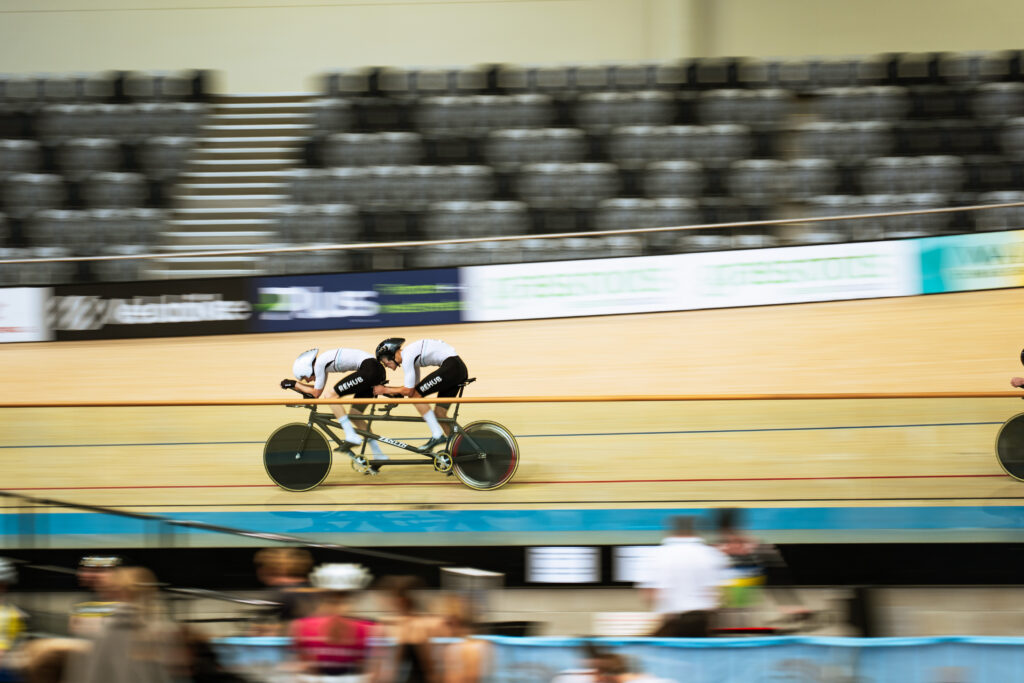
Last year he broke the New Zealand tandem record in the Men’s 4000m Individual Pursuit before taking another 11 seconds off the mark alongside pilot and coach Dan Gardner, recording 4:25.36 earlier this month.
Balancing around 75km of running each week with multiple Para cycling and strength and conditioning sessions is unquestionably time-consuming. Yet Michael believes the disciplines complement one another.
“It is a very different sensation on a tandem bike compared to when I’m running as a T13 Para athlete,” he explains. “I run without being tethered to a guide when running but there is a camaraderie of being on the tandem with a pilot. From a performance perspective, Para cycling allows me to build a bigger aerobic base without the injury risk of running, and I also find being on the bike is a good recovery tool from running.”
Although he loves both Para athletics and Para cycling, Michael does not want to choose between them. Instead, his curiosity and endurance make Para triathlon a natural next step.
“Finding time in my life to also train for Para triathlon presents some challenges, but my capacity and hunger for training just keeps growing over time,” he explains.
“To win a medal at the Paralympics (in Para triathlon) I know I would likely need to run a 5km somewhere between 16 minutes and 16:30. That sounds very achievable, off the bat, but that’s easy to say when you haven’t pushed yourself to the limit in Para swimming or Para cycling. I know I have a lot of work to do to be competitive – and the level is only getting higher for global Para sport – but I’m really looking forward to the challenge.”
Cover photo by Ethan Verner