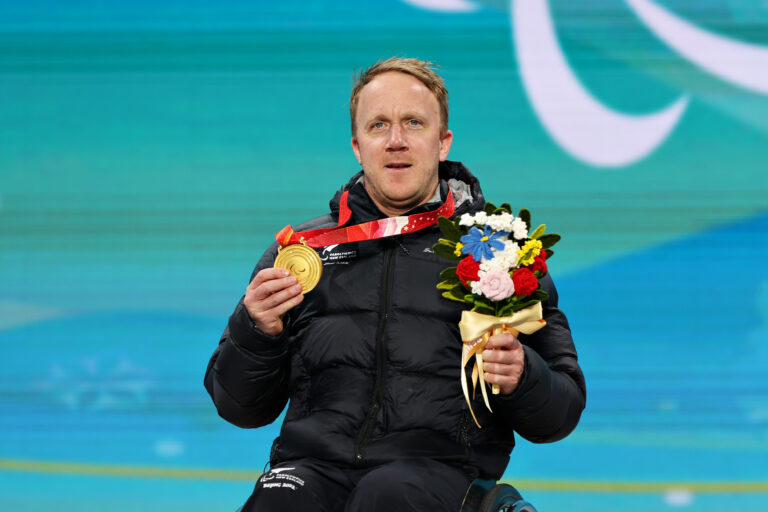
A double Paralympic champion, successful basketball coach, and long-time disability advocate for the Halberg Foundation, few have had a greater impact on Para sport and the wider Paralympic Movement in Aotearoa New Zealand than Paralympian #80 Dave MacCalman MNZM.
Competing in an era when Para sport was gradually shifting from an amateur to a more professional approach, Dave enjoyed the finest moment of his lengthy sporting career at the Sydney 2000 Paralympic Games, winning double gold in the Men’s Javelin F52 and Men’s Pentathlon F52. In doing so, he became one of only four men in the history of the NZ Paralympic Team to win two Para athletics gold medals at a single Paralympic Games.
Yet for the Waihi Beach-based grandfather of six, it has never simply been about chasing glory, awards, or honours.
“I’ve had pinnacle moments in basketball and as a Paralympian in Para athletics, but my real motivation is to give back and make sure I leave the place better than when I found it, and I feel satisfied I have done that,” he explains.
Born in Rotorua to a jazz-singing mother, sport played a hugely important role in his life from an early age. However, after sustaining a dislocated hip while playing rugby at primary school, doctors ruled out any future involvement in contact sport, leading him to discover a passion for basketball.
After relocating to Wellington at the age of 12, he quickly showed outstanding promise in the sport and was later selected as a non-travelling reserve for the national team at the age of 19. Standing at 6ft 5in, Dave spent the 1979 season playing for the Brisbane Bullets in the Australian National League, where he achieved a unique feat.
“I played in the first ever televised NBL game and was the first Kiwi to play in the league,” he explains.
Later that year, Dave earned a basketball scholarship to the United States, moving to California to study and play at West Hills Community College. He thrived in the environment and improved markedly as a player, only for the trajectory of his life to change forever on 19 May 1980.
“It was a really hot day, around 40°C, and a few weeks earlier the locals had shown me a swimming hole where I could cool off,” recalls Dave. “We had just finished the school year, so we grabbed a few beers. I dove in, but the water level had changed from a few weeks earlier and I smacked my head on the concrete.”
He sustained serious spinal injuries in the accident and, without medical insurance, was fortunate that his basketball coach ensured he received the appropriate medical treatment.
Aged just 21, Dave returned to New Zealand several months later to continue his rehabilitation at the Ōtara Spinal Unit in Auckland. He found the experience immensely challenging but, through sheer perseverance, made sure he could shower independently and dress himself.
After leaving the spinal unit, he spent time living with his father in Rotorua and his brother in Taupō before eventually settling in the central Auckland suburb of Ponsonby. Shortly after arriving in the “City of Sails”, he was presented with an unexpected sporting opportunity when he was asked to coach the Auckland junior basketball team.
“The seed had been planted to coach back in the US when the college coach who recruited me introduced me to the book Practical Modern Basketball by John Wooden. Auckland Juniors set me on a coaching journey which was to last for many years.”
The first – and according to Dave, still the only – wheelchair user to coach high-ranking non-disabled basketball teams in Aotearoa New Zealand, he has always appreciated the support shown by the basketball community.
“I never felt any resistance to coaching non-disabled basketball,” he explains. “I might have had a few difficulties explaining movement patterns and footwork from a wheelchair, but I developed ways of explaining this by using my hands. I never felt any negativity towards me from any quarter.”
Running parallel to his basketball coaching career was his introduction to Para athletics in the early 1980s. A regular competitor, he performed strongly in both throwing events and wheelchair racing, and for a period trained alongside Paralympian #48 Rob Courtney MNZM, who won gold in the Men’s 100m at the Stoke Mandeville/New York 1984 Paralympic Games.
Yet for much of the following decade, basketball coaching remained his primary focus. He spent several years coaching in Whangārei before returning to Auckland, where he guided Waitematā from the third division to the first division of the national league. Such was his commitment to coaching at that time he chose not to pursue selection for the Seoul 1988 Paralympic Games.
In the early Nineties, Dave was also proud of initiating the start of two new national Para sport organisations – Wheelchair Basketball New Zealand and New Zealand Wheelchair Rugby, where he served as an administrator, player and coach.
However, it was shortly after moving from Auckland to his current home in Waihi Beach, when he decided to focus fully on Para athletics and selection for Barcelona 1992.
“I was aged in my early 30s at the time, and I felt the time was right to give the Paralympics a go and test how good I could be. We had also moved into a new family situation, and it became difficult to coach high-performance sport from where I was living.”
A versatile Para athlete, Dave carried out much of his javelin and shot training on his one-acre property. Supported by the Katikati Lions Club, which helped raise funds for a new racing chair sourced from the US, he regularly completed long training pushes along the 10km stretch of road running parallel to Waihi Beach.
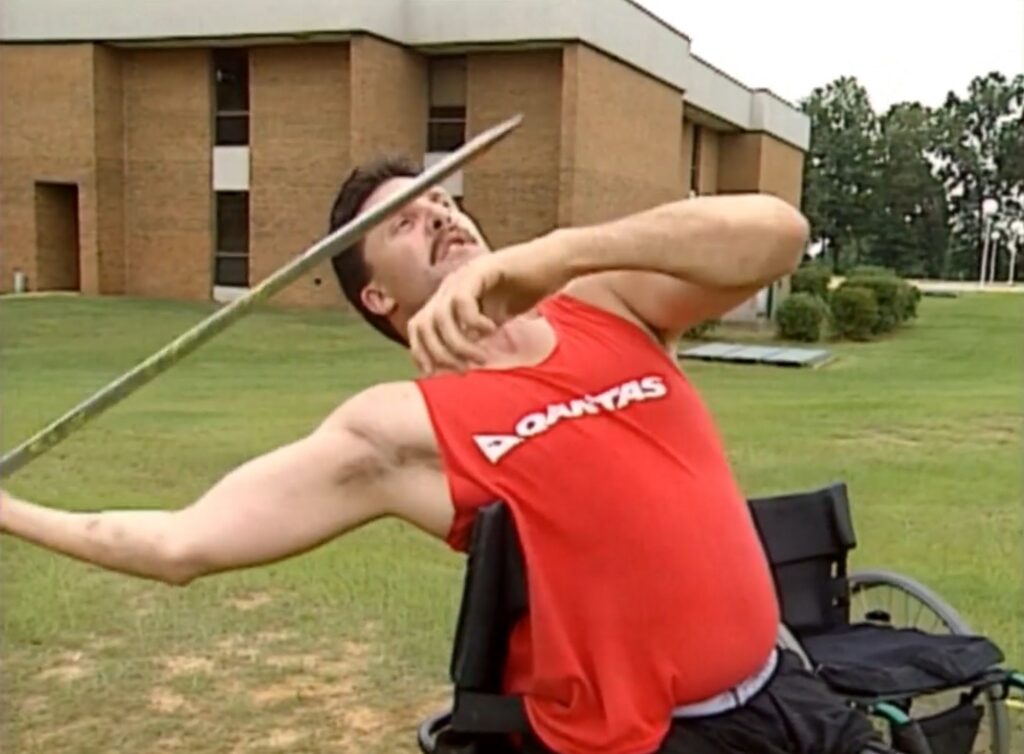
Winning two silver medals and a bronze at the 1989 FESPIC Games in Japan provided genuine encouragement that he could succeed on the international stage.
Earning selection for the 13-strong NZ Paralympic Team for Barcelona 1992 – where he was also named Team Captain – was a “real honour” for Dave. Featuring as one of the central Paralympians in the groundbreaking documentary Twelve Days of Glory was another cherished memory. However, just six weeks before the Games, he received the disappointing news that the pentathlon, his primary event, had been removed from the schedule.
“It was a huge blow because I probably would have won a medal in that event,” explains Dave.
Competing in five track and field events at Barcelona 1992, he nonetheless performed admirably, finishing fourth in the Men’s Shot Put THW2 – missing the podium by just 2cm – while also placing fifth in the Men’s Javelin THW2.
“Barcelona was colourful, magical, and life-changing,” he says. “I was part of a small team of Para athletes, but it was great to be involved in the documentary with Paul Holmes and Chas Toogood. It was also incredible to watch wheelchair basketball at the highest level. Basketball NZ also asked me to represent New Zealand at a FIBA Council for Disability meeting in Barcelona. There I met the movers and shakers in Wheelchair basketball and also got to meet Sir Philip Craven, who later became president of the IPC.”
Showing tremendous versatility, Dave also competed in a raft of marathons, recording a time of 2:10:16 for the Oita Marathon in Japan – a mark which still stands today as a New Zealand marathon T52 record.
With the emergence of Paralympian #100 Peter Martin MNZM as one of his chief rivals, Dave was forced to dig deep in the lead-up to Atlanta 1996. After previously being self-coached, from 1995 he worked alongside Andy Roche, a former Commonwealth Games wrestler and father of Paralympian #134 Stacey Roche.
Andy became an important sounding board, and Dave’s performances improved significantly in the lead-up to Atlanta 1996.
“Andy didn’t know much about throwing, but he made a difference by asking questions that made me more self-aware,” explains Dave. “He was also influential in setting up a throwing area at the Katikati Wrestling Club during winter. We built a real partnership over time.”
Competing in hot conditions in Atlanta, Dave smashed the world record in the Men’s Javelin F52, only to be overtaken in the final round by Iranian thrower Ghader Modabber Raz.
Frustrated to settle for silver, he nonetheless approached Sydney 2000 with renewed purpose. Buoyed by world-record performances to win gold in the Pentathlon F51–F53 and Shot Put F52, as well as silver in the Javelin F52 at the 1998 World Para Athletics Championships in Birmingham, he felt he was reaching his peak ahead of his third Paralympic Games.
Drawing energy and motivation from his rivalry with Peter Martin, Dave gained additional confidence after setting world records in the pentathlon, shot put, and javelin at the Swiss Nationals just weeks before Sydney 2000.
With the pentathlon restored to the Paralympic programme, he opened his campaign inside the cavernous Stadium Australia by winning gold in the Men’s Javelin F52, courtesy of a world record throw of 16.19m.
In his favoured pentathlon, he was even more dominant. Holding a commanding lead heading into the 800m – the fifth and final event – he survived an unusual incident involving Peter Martin to secure his second gold medal.
“I asked Peter if he wanted to push together in the 800m. He was lying in silver at the time, and I thought it would be a great image for the NZ Paralympic Team to come across the line together. But Peter said he wasn’t sure how he was feeling. He instead took off and I followed him, but as he started to slow down with about 200m remaining, my steering didn’t activate properly and our chairs touched, causing us both to stop.”
Both athletes managed to finish the race, although Dave was disqualified from the 800m. Fortunately, the points he had accumulated in the 100m, shot put, javelin, and discus were enough to secure gold with 4195 points. Martin also reached the podium, claiming bronze.
Just missing out on a third medal after finishing fourth in the Men’s Shot Put F52, Dave could still reflect on Sydney 2000 with immense pride and satisfaction.
“It meant the world to me,” he explains. “Since I first started bouncing a basketball, I wondered if I would ever become that good. Sydney 2000 was that moment of athletic fulfilment.”
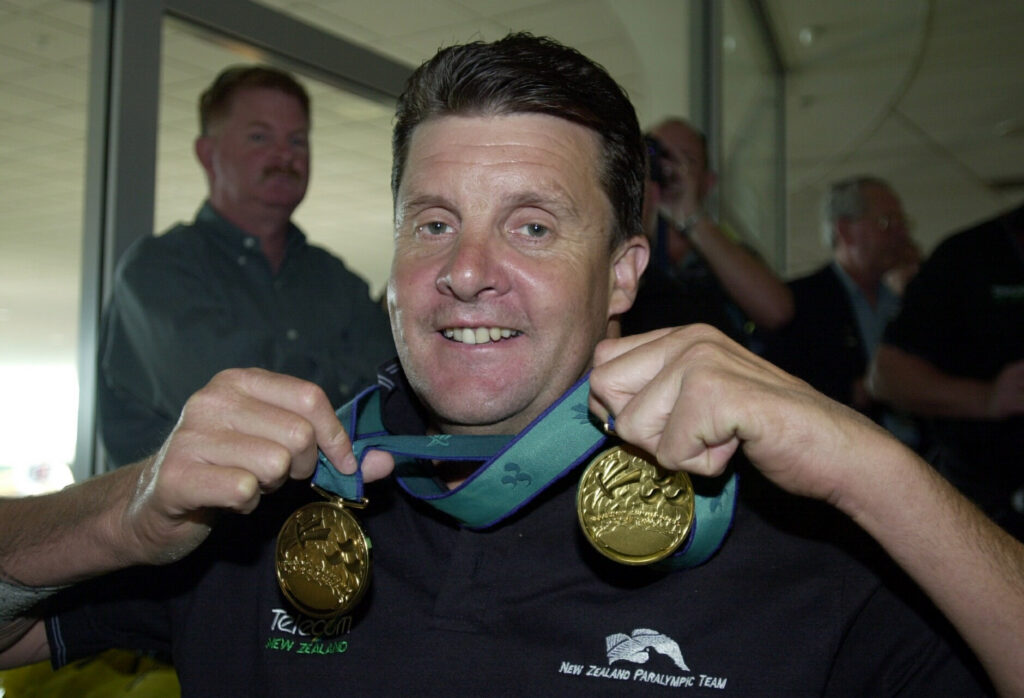
Dave later won silver medals in the Shot Put F52 and Javelin F52 at the 2002 World Para Athletics Championships in Lille. However, by the time he arrived at his fourth Paralympic Games at Athens 2004, he was 46 years old and struggling with heart fibrillation, and he was unable to add to his Paralympic medal haul.
Athens proved to be the final chapter of his competitive career. The following year, he accepted a role for the Halberg Foundation as regional advisor for the Waikato region – which he served for 14 years – before transitioning to the Bay of Plenty and Gisborne region before retirement in 2023.
Driven by a desire to give back to Para sport, Dave found the role deeply rewarding, helping young Para athletes access opportunities to participate in Para sport. He also played an influential role in improving disability infrastructure within communities and has watched with pride as elite Para sport in Aotearoa New Zealand has continued to evolve.
Now aged 67, Dave looks back fondly on the many friendships and experiences sport and Para sport have brought him, and he strongly encourages people with disabilities to give Para sport a try.
“I would say, for the same reason sport is good for anyone – the thrill of competition, the social connections, the friendships, and the self-awareness you can develop. That’s what Para sport can give you.”
***To read more about Dave MacCalman check out details of his autobiography here,