Perhaps few people have made quite the same wide-ranging impact on Para sport in Aotearoa New Zealand as Paralympian #107 Grant Sharman MNZM.
An influential figure in Wheelchair rugby, Grant claimed back-to-back Paralympic Games bronze medals as a Para athlete, before guiding the Wheel Blacks to a momentous gold medal at Athens 2004.
Later working as the High Performance Director at Paralympics New Zealand (PNZ) he laid the critical groundwork of the future success of the NZ Paralympic Team and successfully switched sports, claiming World Cup finals placings in Shooting Para sport.
Earlier this year Grant became a worthy recipient of the PNZ Order of Merit – which recognises individuals who have given outstanding service to the organisation and Paralympic sport.
“Sport has given me so much,” explains Grant. “It put me in a wheelchair, it got me to this point, it has played a massive part in my life. I have received so much from sport.”
Raised in West Auckland the only son of English immigrants, Joyce and George, he loved sport as a youngster but modestly describes himself as “average at best.”
A “half-decent” long-distance runner he also enjoyed rugby and hockey, and it was during an inter-house rugby game at King’s College at the age of 15 where the trajectory of Grant’s life would change forever.
Suffering a “freak” injury in the game he recalls “feeling terrified” in the wake of his injury and became the first person transferred to the Otara Spinal Unit.
“Back in 1977 people were still figuring out about spinal injuries,” he said. “Back then we were an unknown quantity, there was not the same awareness that there is today. They were literally learning on the job. Apart from my mum and dad I had no support. I was told initially I only had ten years to live, and I thought the rest of my life would be spent living in the spinal unit.”
Yet Grant has always possessed a positive mindset, preferring to take on challenges with confidence and grasp opportunities that come his way. After it quickly became likely that his life expectancy would be significantly longer than ten years, he competed at the 1978 National Paraplegic Championships competing in Para athletics, Para table tennis and Para bowls.
“Things fell my way,” he recalls. “Opportunities came along. I was fortunate to be surrounded by great people. My dad was a massive support, my wife, Jenny, has been a massive support too. I’ve always had people help me along the way.”
In 1980 he took up a job as a receptionist and first engaged with mouth painting, where he would develop into a highly acclaimed professional artist. However, following the introduction of Wheelchair rugby – then known as ‘Murderball’ – to New Zealand in the early 1990s, he discovered a game that perfectly suited his character traits.
“I had broken my neck playing rugby, so I liked the thought of playing rugby again,” he says. “I’m also not really into individual sports; I thrive in a team environment.”
Playing for Auckland from 1993, Grant featured for the Wheel Blacks at the 1995 World Championships in Nottwil, Switzerland. Despite the team’s lack of experience, they performed above expectations to beat Great Britain in the bronze medal play-off and provide belief they could challenge at the Atlanta 1996 Paralympic Games.
With the sport making its Paralympic debut in Atlanta, it was a huge moment for Wheelchair rugby and Grant featured in the bronze medal-winning Wheel Blacks, who once again overcame Great Britain to climb the podium.
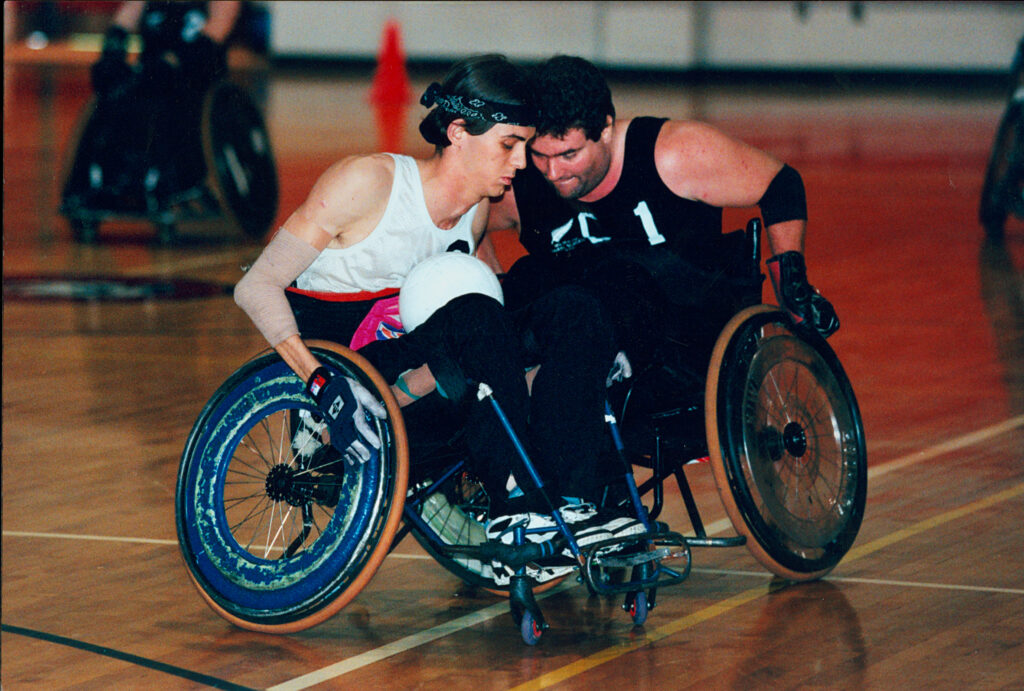
“It is amazing to represent New Zealand” he says. “Knowing that you are competing for this tiny country from the bottom of the world always fills me with pride.”
Grant featured in the New Zealand team which won silver – following a narrow defeat to the USA – at the 1998 World Championships in Toronto, before claiming a second successive Paralympic Games bronze medal at Sydney 2000 with victory over Canada.
The Aucklander retired from playing in 2001, but two years later an opportunity arose to coach the Wheel Blacks after Barry Hislop stepped down from the role. Despite having no prior coaching knowledge, he was motivated to take on the challenge to help guide the Wheel Blacks to gold at Athens 2004.
And, says Grant, he was handed a parting gift, from the outgoing coach, which was to prove critical to their future success. Hislop had worked with Team Psychologist Ashley Light and Strength and Conditioning Coach, Malcolm Humm as part of his coaching team and he insisted Grant should hang on to both.
“As soon as I met them, I knew Ashley and Malcolm were my superpower,” explains Grant. “Ashley was such a good sports psych and Malcolm was so good in that sport science space. I later added Lea Stening, a nutritonist to the team, and through the three of them, I felt I had the main bases covered off.”
It was Ashley who first challenged Grant to write down his coaching philosophy. Initially confused by the question after some thought he realised its value as the philosophy became central to every decision in his coaching career.
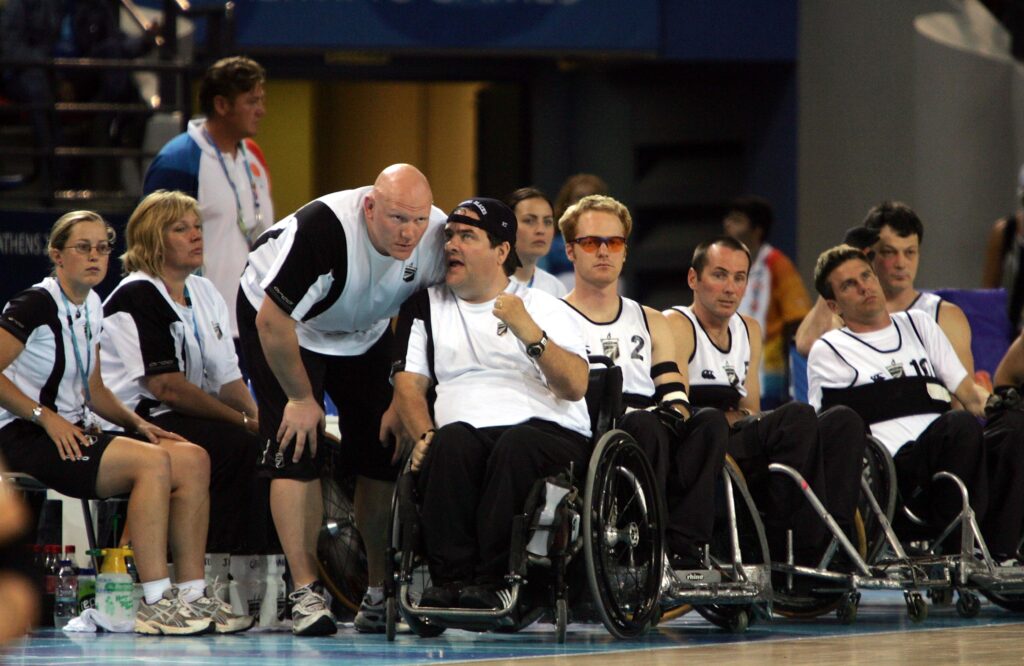
“I had two jobs as coach,” he explains. “The first was to create an environment with the necessary resources to allow the team to best prepare for major events,” he explains. “My second job was to ensure when at the event, the team was in the right environment to achieve its best performance. My strength was setting up the structure, and for the people within that structure to operate with the freedom to carry out that job.”
The next step was to prepare the tactics for the team – and recognising he did not have all the answers, he sought guidance and leadership from two of his premier players – Paralympian #126 Tim Johnson MNZM and Paralympian #129 Bill Oughton.
Grant flew the duo north from Christchurch to meet in Auckland and what took place was a critical meeting, which formed the birth of their Paralympic gold medal winning tactical masterplan.
“I said, we are going to figure stuff out and it won’t be pleasant,” he recalls. “We are going to argue but we will come to a consensus and once we agree, you sell it to the rest of the team. Once you do, we will never argue in front of the team, and we never did.”
In an effort to raise standards, Grant introduced training diaries for each Para athlete and longer more intense training camps. He titled one session the “Gutbuster” to test the physical and mental reserves of his squad.
At Athens 2004, the Wheel Blacks opened their campaign in Group A, with a comprehensive victory over Australia, but following a narrow defeat to the USA in their second group game, Grant was not happy.
In the post-match debrief each player shared one thing which went well and one thing which did not. Grant recalls that the team was “disintegrating” during the debrief only for Paralympian #156 Jai Waite to take his turn.
“Jai was making his Paralympic debut in Athens and was such a great fit for the team,” recalls Grant. “I didn’t play him in that game, but I remember him saying, ‘well, I didn’t get on the court, so I can’t talk about my play, but I feel my haka is improving’. It was the moment the room defused. It was one of the pivotal moments of the competition. A few of the guys were chipping away on the sidelines, but that saved our tournament.”
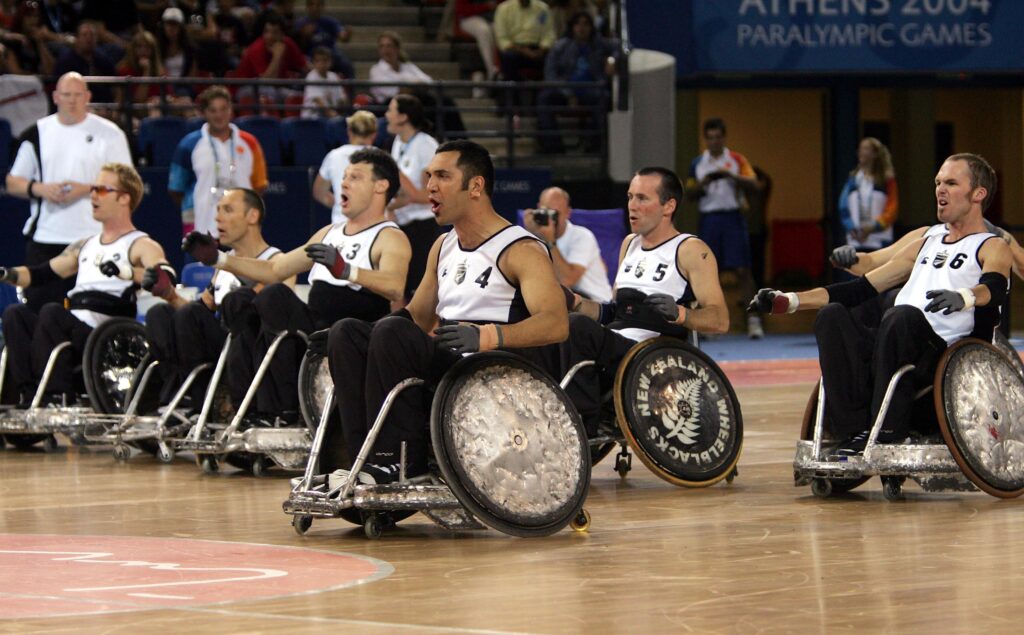
In the quarter finals the Wheel Blacks “destroyed” Belgium 40-33 before dispatching Great Britain in the semi-final to set up a final against Canada who had overcome the USA in a bruising semi.
With the squad singing Sweet Caroline by Neil Diamond on the bus enroute to the final, Grant, supported by Bill and Tim, cooked up a tactical masterplan which was to prove decisive.
“We decided we couldn’t match them for speed, so we’d play a slow game,” he says. “We would play key attack and key defence – and we would try and make sure we were the last to score in every quarter.”
It was a plan that was executed to perfection. Playing like “a machine” New Zealand ran away victors by 31 to 29 to clinch one of the country’s most iconic Paralympic gold medals.
“The Canadian’s made the mistake in figuring we couldn’t play key defence or key attack, and we also managed to score last every quarter. This made them frustrated and they changed their tactics. Those times in sport come around so rarely, I’m thinking like the 2011 or 2015 Rugby World Cups (which the All Blacks won) or like Lydia Ko at the (Paris 2024) Olympics, when everything works.
“After the medal ceremony Tim and Bill put their gold medals around my neck and said, ‘these are for you’. It was an incredibly emotional moment.”
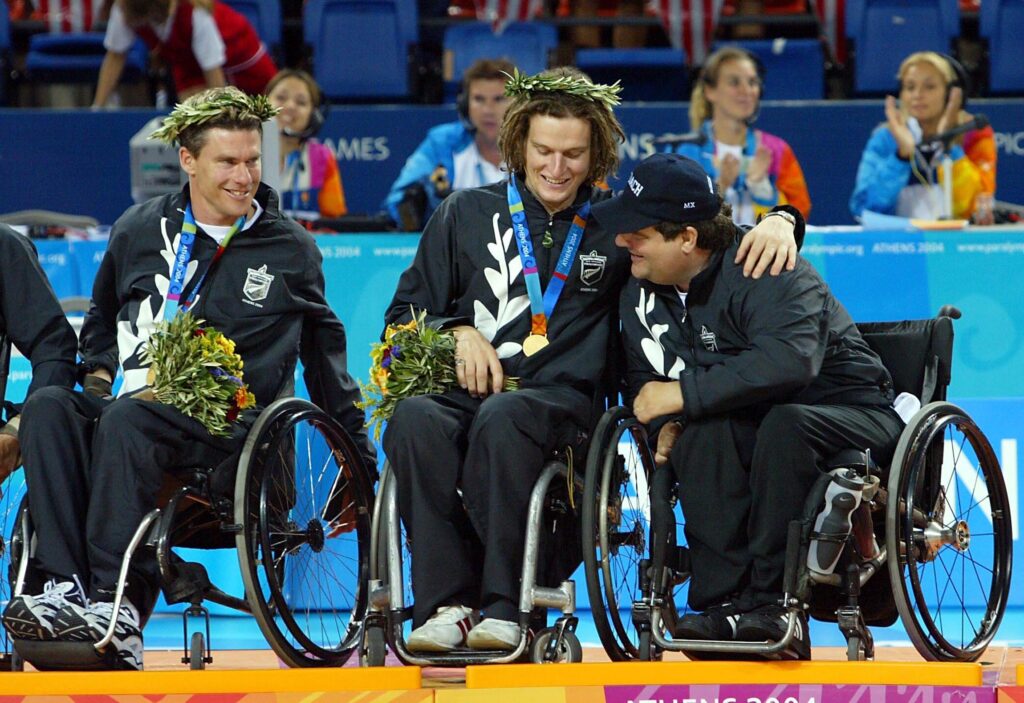
Grant also coached New Zealand to silver at the 2006 World Championships in Christchurch before stepping away from the role.
His “next big” opportunity arose in 2008 when he was appointed the first ever PNZ High Performance Director. Despite having limited experience of Para sports, other than Wheelchair rugby, he worked alongside Malcolm Humm to professionalise Para sport in New Zealand.
“I was just the guy at the start who had the brains to bring on a really good man like Malcolm,” he explains. “We’d plan where the medals were going to come from and transfer talent and target events where we could achieve. We were hunting medals.”
Departing the role in 2011, Grant had built the foundations for the future success of the NZ Paralympic Team which went on to enjoy a golden era, highlighted by an outstanding haul of 21 medals at the Rio 2016 Paralympic Games.
Today he remains a passionate disability advocate and serves as a Board member at Disability Sport Auckland and Catwalk, which funds research to cure spinal cord injuries.
A winner of the 2005 Aucklander of the Year, in 2024 he received the Sir Eion and Jan, Lady Edgar Lifetime Achievement Award for services for the Disability Sports Sector in 2024.
Reflecting on the journey undertaken by Para sport over the past five decades he says the development has been “like advancing from a Model T Ford to a Lamborghini.”
He is proud of the positive involvement he has played in the evolution of the Paralympic Movement in Aotearoa New Zealand and adds: “Success comes from hard work and grabbing the opportunities that life gives you. It is about surrounding yourself with good people and building good relationships, which I’ve been able to do. But what I think I’m most proud of, is giving things a go.”